The ₹4,999 'complete website' template is one of the most expensive things a growing business can buy. That statement sounds counter-intuitive — a template with a one-time fee of five thousand rupees, versus a custom website that might cost fifty thousand or more, seems like the obvious economic winner. The math falls apart the moment you extend the timeline past six months and include the costs almost no one factors in: speed, SEO, maintenance, security, and the compounding cost of a site that quietly fails to convert.
This article is not a hit piece on templates. There are legitimate use cases for them — a wedding invitation site, a temporary landing page for an event, a hobby project. What this article is against is the framing that a template is a cheap alternative to a custom website for a growing business. That framing has cost hundreds of businesses we've spoken to more than the price of the custom site they should have built in the first place.
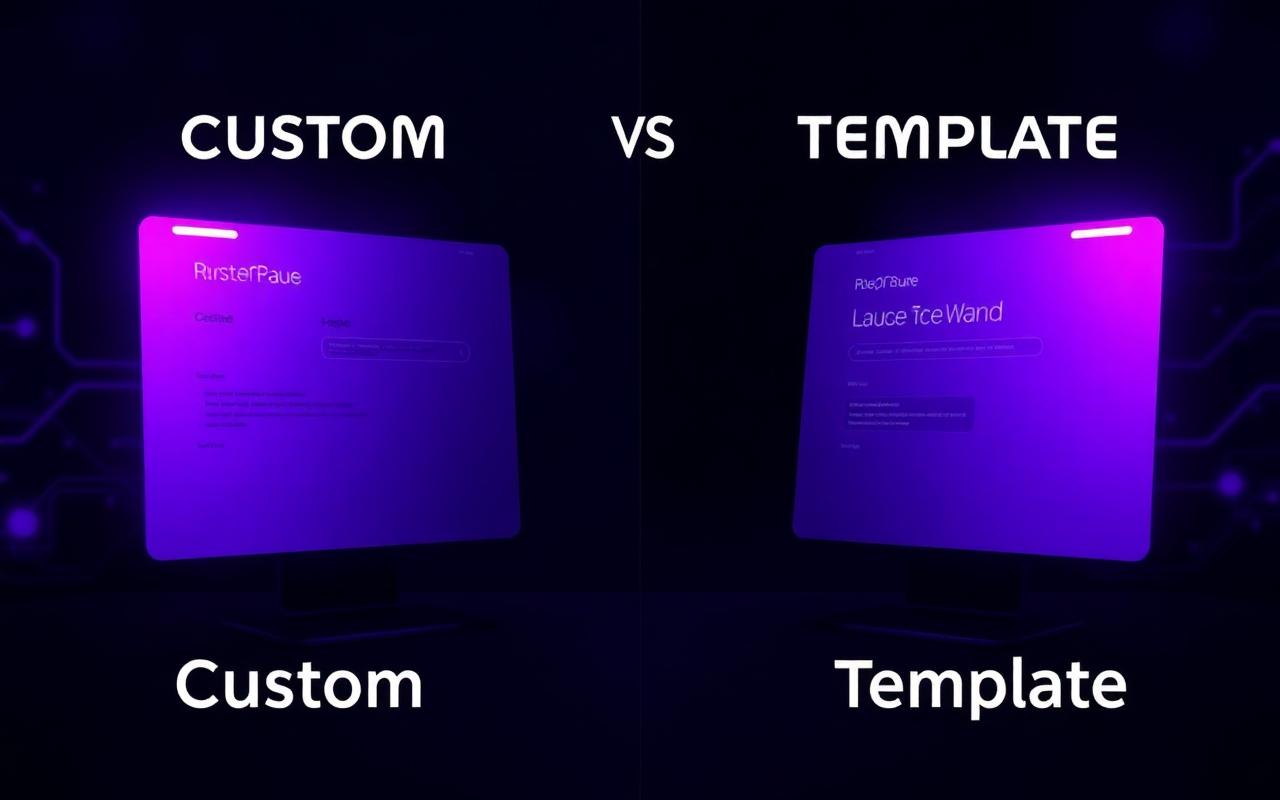
The specific comparison
Throughout this article, 'template' means a downloaded or purchased WordPress/Wix/Shopify theme customised lightly. 'Custom' means a bespoke design and build using a modern framework (React, TanStack, Next.js) or a hand-crafted WordPress theme with only the plugins the site actually needs.
Hidden Cost #1 — Speed
Templates are built for maximum flexibility. They ship with 30 to 60 plugins to cover every possible use case: sliders you'll never use, animation libraries for effects you'll never enable, e-commerce hooks on a site that will never sell anything, form builders duplicating each other. Your business uses maybe five of those features. The other 55 still load on every page.
The performance data on this is consistent. Google's research shows that mobile bounce rates increase by 32% when page load time goes from 1 second to 3 seconds, and by 90% when it goes from 1 second to 5 seconds. On template sites we audit for prospects, the median mobile LCP (Largest Contentful Paint) is 4.8 seconds. On custom-built sites we ship, it is 1.6 seconds. That is not a rounding error — that is the difference between a site that converts 3% of visitors and one that converts 5%.
Translate that into rupees. A local service business receiving 5,000 visitors a month at a 3% form-conversion is booking 150 enquiries. The same business on a fast custom site converting 5% books 250. If each enquiry is worth ₹200 in gross profit, that is a ₹20,000 monthly difference. Two months of that gap pays the difference between a template and a custom build.
Hidden Cost #2 — SEO
Google's Core Web Vitals — LCP, INP (Interaction to Next Paint), and CLS (Cumulative Layout Shift) — are ranking signals for mobile search. Not tiebreakers; ranking signals. Template sites fail Core Web Vitals at scale because of exactly the same bloat that hurts speed. Duplicated DOM elements from overlapping plugins, mystery scripts blocking the main thread, and third-party fonts loaded from four different origins are template hallmarks.
There is a second, subtler SEO cost. Templates ship with a fixed page structure. To rank for a niche keyword ('polycrystalline solar panels Bhavnagar'), you often need a page structure that matches the search intent — an FAQ block, a comparison table, structured data, city-specific testimonials. On a template, that either isn't possible or requires a page-builder Frankenstein that hurts speed further. On a custom site, it's a two-hour job.
The compounding cost of poor SEO
SEO is not a fixed cost. Every month you rank on page 2 instead of page 1 is a month of lost organic traffic that competitors are capturing instead. Over 24 months, the difference between a site that ranks in the top 3 and one that ranks on page 2 for the same keywords can be the entire growth trajectory of the business.
Hidden Cost #3 — Maintenance
Every plugin is an attack surface. Every theme is a maintenance obligation. The average template-based WordPress site we take over has 34 plugins. Each one needs updating, ideally within a week of the security patch being released. Miss those updates and the site gets hacked — not maybe, will. Redirect malware, cryptomining scripts, and Chinese-medicine spam pages are the three most common infections we clean up.
The all-in maintenance cost for a template-based site — plugin updates, security scans, backup subscriptions, hosting optimised for a bloated stack, and the occasional emergency clean-up — averages ₹15,000 to ₹30,000 per year. Over three years, that adds ₹45,000 to ₹90,000 to the total cost of ownership. Custom sites, built on a lean stack, run at roughly a third of that.
The hack you don't see for six months
Well-designed WordPress infections don't crash the site. They quietly inject spam pages into your sitemap. You find out six months later when Google issues a manual penalty and organic traffic falls by 80% overnight. Recovery takes months.
Hidden Cost #4 — Design That Doesn't Fit the Business
This is the softest cost and often the largest. A template is designed for the median business in its category. Your business is not the median. Your positioning, your pricing, your differentiation — none of it fits into the template's opinionated structure. So you compromise. You cut the copy that would have made your service page compelling because it doesn't fit the template's hero. You hide the comparison table you should feature because the template puts it in the footer. You settle.
Every settled compromise is a small, invisible reduction in conversion. In aggregate, the compromises make the site do a worse job of selling than a custom build would have. The customer will never know what they missed. You never see the enquiries you didn't get.
Hidden Cost #5 — Lock-in and Migration
Templates create lock-in through their own plugin ecosystem. Two years in, you have a site running six page-builder plugins, three form plugins, a custom-fields plugin, and a caching plugin fighting with a CDN plugin. Migrating away requires a full rebuild — which is what should have happened at day zero.
We have quoted more than 40 'template rescue' projects in the last two years. The scope is almost always identical: rebuild the entire site custom, preserve the URL structure, migrate the content. The cost of these rescues is 20–40% higher than a custom build would have been at day zero, because now we're also fighting the redirect map, the legacy CMS, and the fragility of the client's existing data.
The Custom Alternative — Actual Economics
A custom-built marketing site for a small-to-mid Indian business runs ₹50,000 to ₹1,50,000 depending on scope. That number is higher than a template. Over a 36-month ownership horizon, here is how the total cost of ownership actually compares:
The nominal cost gap is ₹40,000 over three years. The revenue gap, driven by better conversion rates and better SEO rankings, is usually somewhere between one and ten times that number depending on how much traffic the site receives. In every real client scenario we've modelled, the custom site pays for itself inside the first 12 months of ownership.
When Templates Actually Make Sense
Not every project needs a custom build. Templates are the right call when:
- The site is temporary — an event landing page, a wedding site, a hackathon microsite
- You are pre-revenue and need a placeholder to validate positioning
- You are a hobbyist or non-commercial project with no growth ambition
- You have a very specific need (portfolio, resume site) with no business dependency
If none of those apply — if your website is part of a business you are actively trying to grow — the template is a false economy. Build custom. Build it once. Build it well.
Practical Advice If You're Already on a Template
If you have a template site and it's currently working, don't panic-migrate. But do audit it against a specific set of criteria and start planning the rebuild for the next fiscal year:
- 1Run PageSpeed Insights on your top 5 pages, mobile. If any LCP is above 3 seconds, you have a problem.
- 2Count your active plugins. Above 20 is a red flag; above 40 is a fire.
- 3Check the last time each plugin was updated. Any plugin unmaintained for over 12 months is a security risk.
- 4Pull Search Console and note which pages have declining impressions over the last 6 months.
- 5Model the cost of a custom rebuild vs the cost of another year of maintenance plus lost conversion. Almost always, the rebuild wins.
Frequently asked questions
But my template site works fine — why change?
'Works fine' usually means 'loads eventually and doesn't crash daily.' The right question is not 'does it work' but 'what is it costing me in conversions and rankings that I never see?'
Can you make a template site fast?
To some extent, yes — we do template optimisation engagements. But we'll be honest: the ceiling is roughly 70% of what a clean custom build achieves, and the fix has to be redone after every major theme update.
What about page-builder tools like Elementor?
Same problem, one layer up. Page builders add 300–500 KB of JavaScript per page before your content loads. They're fine for a hobby site; they're not fine for a business site chasing Core Web Vitals.
How much should a good custom website cost in India?
A well-built custom marketing site for an SMB in India costs between ₹50,000 and ₹1,50,000 depending on scope. Anyone quoting under ₹25,000 for custom is either a beginner or is quietly delivering a template with a custom coat of paint.
Is WordPress always bad?
No. A lean WordPress site built with a custom theme and 5–8 essential plugins is a perfectly good option, especially when the editorial team needs a familiar CMS. WordPress becomes bad when it turns into 40 plugins and a page builder.
Conclusion
Templates are cheap upfront and expensive forever. Custom is expensive upfront and cheap forever. For any business planning to grow, the custom build is the correct economic decision — often by a wide margin — as long as you take the ownership horizon seriously.
Written by
Ajay Bhojani
Co Founder & CTO · RoTechX